
Set the budget
Assign every rupee before the month starts
Categories for rent, EMI, groceries, and everything else, until income minus assignments hits ₹0.
Every well-known zero-based budgeting app is priced in dollars and built around a bank account that isn't Indian. Spenrol was built the other way round: free, and designed for UPI from day one, so a ₹45,000 salary gets planned in rupees, not converted from someone else's system.
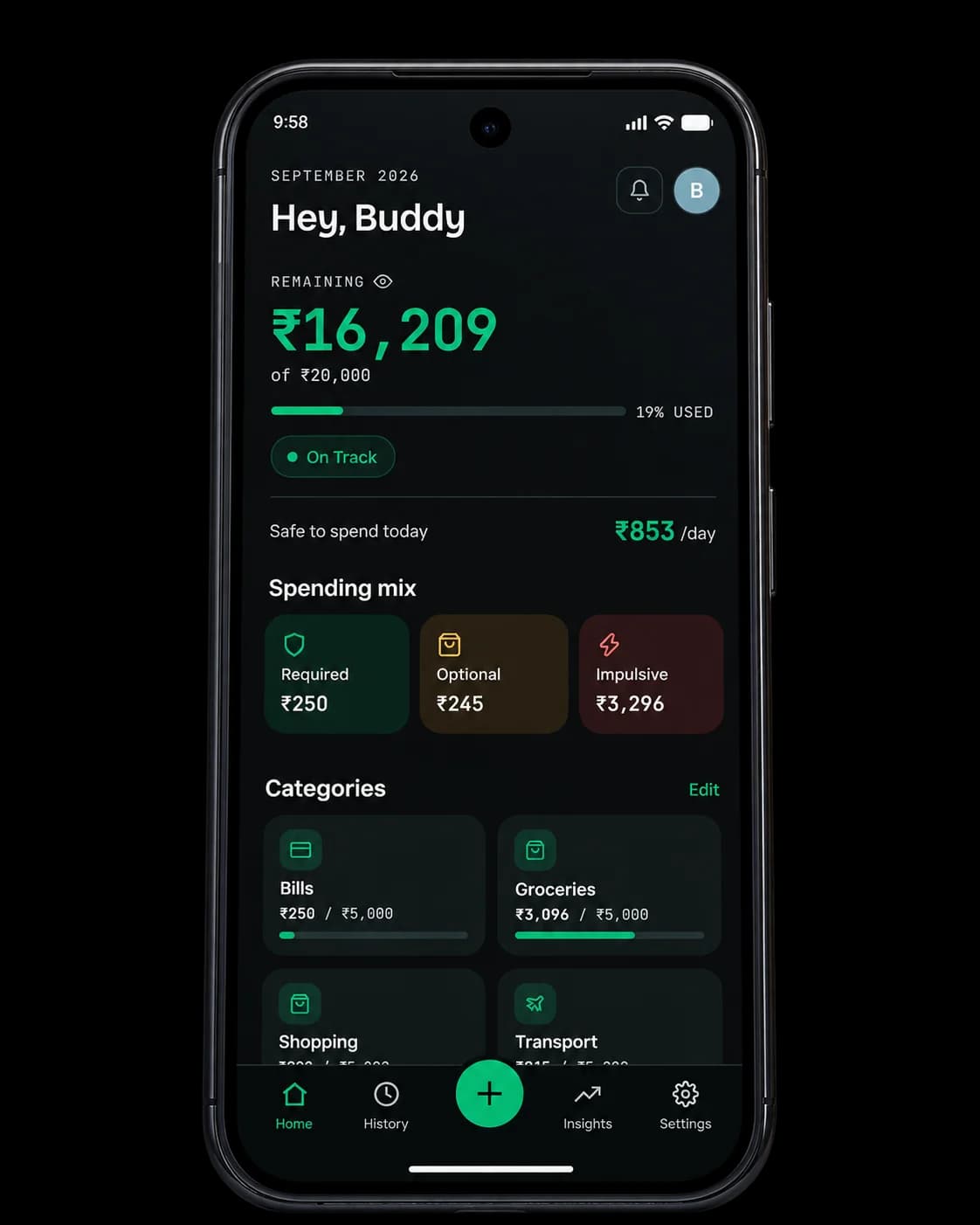
Safe to spend today
₹853/day
₹16,209 left · 19 days to go
Salary · ₹45,000
Left to assign₹0
Zero-based budgeting comes down to one piece of arithmetic: income minus what you've assigned equals ₹0. That doesn't mean you spent it all by the end of the month. It means you decided where every rupee was going before the month even started.
Take a ₹45,000 salary as an example. ₹15,000 goes to rent, ₹6,000 to the EMI, another ₹5,000 for groceries. SIPs and savings take ₹8,000, transport and subscriptions ₹4,000. Whatever's left, ₹7,000, is what you've actually decided to spend on food delivery, going out, whatever you want that month. Add it up and it comes to ₹0.
By month-end you're not trying to reconstruct where the money went. You already know, because you decided it weeks earlier.
It holds up when the month isn't normal, too. A wedding invite, a festival, a sudden repair bill: give each one its own category, funded by a buffer you set aside on purpose. Otherwise you're quietly eating into your grocery money without noticing. And if a category does run dry early, you're the one choosing what happens next. Move rupees over from somewhere with room, or let that category be over for the month. Either way it's a decision, not something you find out by accident.
None of this is a new idea. YNAB built an entire company around zero-based budgeting, and it's a good method. The issue for Indian users was never the method. It's everything wrapped around it.
YNAB charges $109 a year, billed in US dollars, and its bank-sync runs on Plaid, which doesn't connect to Indian banks. So you'd be paying a dollar subscription for a feature that doesn't work with your account, and typing every transaction in by hand regardless.
Goodbudget takes a different approach: the envelope method, a relative of zero-based budgeting but not quite the same thing. It's free, which helps, except the free plan tops out at 20 envelopes. Rent, EMI, SIPs, groceries, food delivery, transport, subscriptions, money you send home: that alone can eat most of your twenty before you've made room for anything else.
The India-focused apps come with a different catch. Several of the popular ones work by reading your SMS or notifications to log spending automatically, then make money by layering lending products on top of that data. Fine if what you want is a record of what already happened. Not much help for deciding, in advance, where a rupee is supposed to go.
It matters because the problem behind all this is real: a 2024 IIIT Delhi study found that 74% of UPI users say they've spent more since they started using it. (source) A budgeting app designed for a different banking system doesn't fix that. Neither does a tracker whose business model depends on selling you a loan.
Set the budget
Categories for rent, EMI, groceries, and everything else, until income minus assignments hits ₹0.
Capture via screenshot
The screenshot is read on your phone and fills in the amount, merchant and category. You can also type it in.
Tag the intent
Spenrol never guesses this from the screenshot. You decide each time.
See what's left
One number that rolls up every category's remaining budget into what's safe to spend right now.
Same underlying discipline as YNAB and EveryDollar, minus the dollar pricing and a bank-sync feature that was never going to reach an Indian account.
| Feature | YNAB | Goodbudget | EveryDollar | Spenrol |
|---|---|---|---|---|
| Price | $109/yr | Free (20-envelope cap) | Free, or $79.99/yr Premium | Free |
| Method | Zero-based | Envelope | Zero-based | Zero-based |
| No bank login required | — | — | ||
| Built for UPI India | — | — | — | |
| Intent tags (required/optional/impulsive) | — | — | — |
See the full field, including Money Manager and Monefy, in our zero-based budgeting app comparison.
Free on Android.
No SMS access, no card required.
Something else? Write to [email protected]
Before the month starts, you plan where every rupee goes: rent, groceries, EMI, SIP, savings, fun money. Nothing is left unassigned. Income minus what you've planned comes out to ₹0, so you aren't working it out from a bank statement afterwards.
Yes. There's no paid tier and no ads. For comparison, YNAB bills $109 a year in US dollars.
Not yet. Spenrol is on Android now, free on Google Play. Join the iPhone waitlist and we'll email you once, when it's ready.
No. Spenrol never asks for your bank login, and it doesn't need SMS access. You share a UPI payment screenshot, which is read on your phone to fill in the amount, merchant and category, or you type the spend in. The intent tag is always yours to pick.
Envelope budgeting splits your cash into buckets you top up as you go. Zero-based budgeting works from your total income outward and puts every rupee into a category before the month begins, so nothing is left unassigned. Goodbudget's free tier also caps you at 20 envelopes. Once you count rent, EMI, SIPs, groceries, food delivery, transport, subscriptions, and money sent home, most households need more than that.
Yes. Zero-based budgeting, screenshot capture and intent tagging are all in the Android app today, free.
“Being able to classify expenses as Required, Optional, or Impulsive makes it easier for me to understand my spending habits. It also makes me think twice before spending on something impulsively.”
Zero-based budgeting, built for UPI India from the start. No dollar subscription, no bank login required.

Scan to download on your phone